
A hormone binds its receptor. An antibody recognizes its target. A drug alters a protein’s activity. These molecular encounters connect events at the nanometer scale to consequences felt throughout the body. Understanding how molecules assemble and interact is central to explaining how life works, what goes wrong in disease, and how medicines can intervene. At the heart of these interactions lie three-dimensional structures: how molecules take shape and fit together.
We introduce Mol-1, an open-weight biomolecular foundation model for predicting molecular complexes and interactions, and generating drug candidates. On the benchmarks reported here, Mol-1 is, to our knowledge, the first open-weight model to match the performance of frontier closed models.
By releasing Mol-1’s weights, we put frontier biomolecular modeling directly into researchers’ hands—enabling them to run it on their own infrastructure, adapt it to specialized targets and datasets, and develop new methods on top of it. This gives the research community the freedom to turn a shared foundation into purpose-built tools for structure prediction, drug design, and therapeutic discovery.
Mol-1: Strong Performance across Key Drug Modalities
We built Mol-1 as a biomolecular foundation model for interactions central to drug discovery. A single base-model checkpoint predicts antibody–antigen, protein–peptide, protein–small-molecule, and molecular-glue complexes. This shared foundation allows researchers to investigate different therapeutic approaches using the same model.
Antibody–Antigen Complexes
On FoldBench-AB, Mol-1 achieves a 75.0% success rate, compared with 70.0% for the strongest open baseline shown in our evaluation (Figure 1 - a). This result is close to the 75.58% reported for IsoDDE in Isomorphic Labs’ technical report. We also tested how much the result varies with seed bootstrapping. Across all 201,376 five-seed subsets drawn from a pool of 32 seeds, 62.22% tests achieved at least 75% success and 17.85% exceeded 76% (Figure 1 - f).
In antibody discovery, prior experiments or studies often provide information about the antigen binding region (epitope) even when the complex structure remains unknown. With epitope input, Mol-1-Constraint reaches 88.3% on FoldBench-AB (Figure 1 - a).
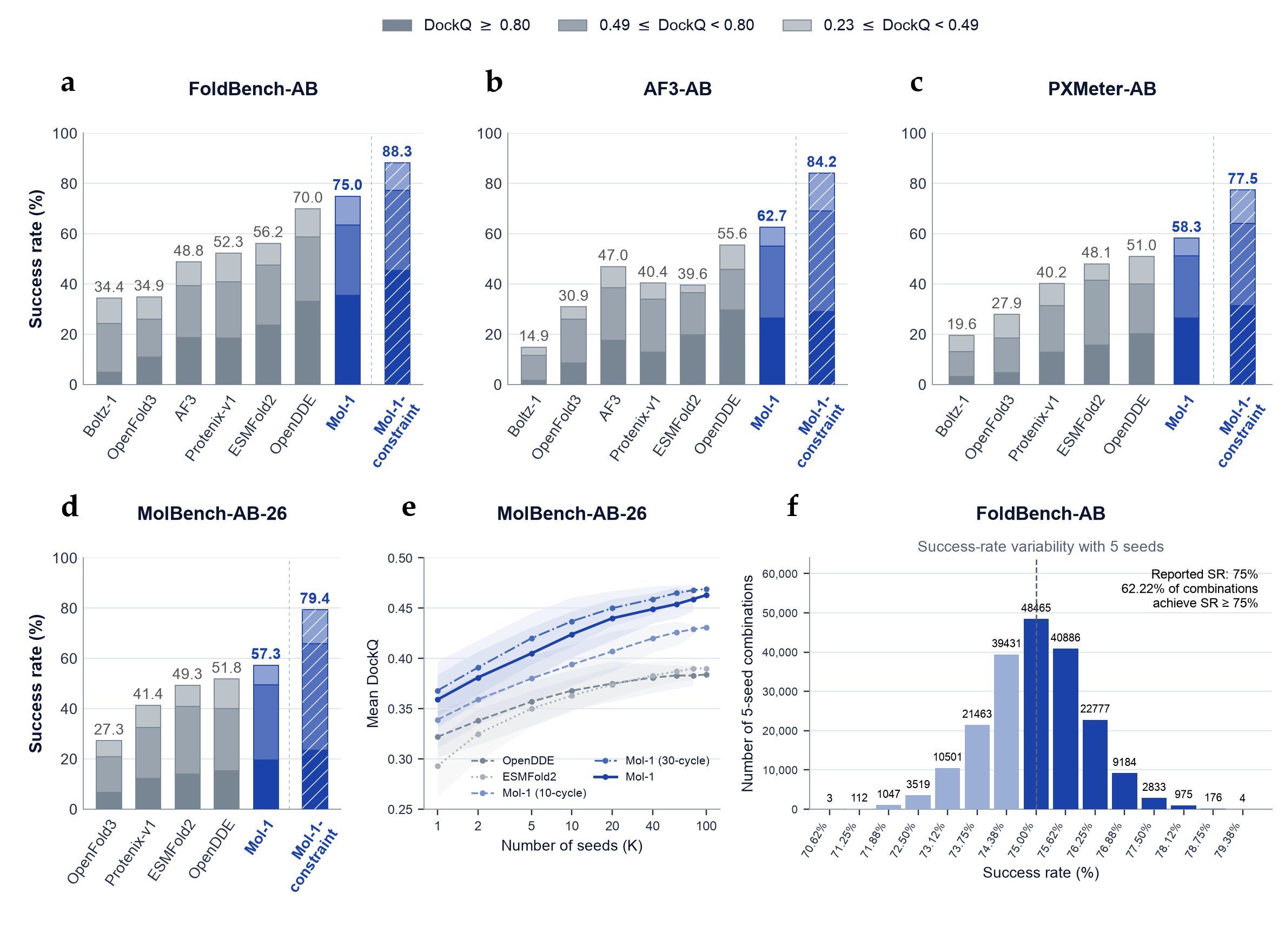
Mol-1 also exceeds the open baselines significantly on three other antibody benchmarks, reaching 62.7% on AF3-AB, 58.3% on PXMeter-AB, and 57.3% on MolBench-AB-26 (Figure 1 - b through d). Mol-1-Constraint further improves the prediction accuracy by ~20% on each benchmark.
Mol-1 exhibits great test-time scaling capability as well. We evaluated this on MolBench-AB-26 by varying both the number of random seeds and the depth of recycling, the repeated computation that refines the model’s internal representations before structure generation. More seeds explore alternative candidates; deeper recycling gives each prediction path more refinement. Figure 1 - e shows that Mol-1 gains performance significantly from both and the performance gain is more significant compared to other models like OpenDDE.
Small Molecules and Molecular Glues
Predicting a protein–ligand complex requires accurately recovering both the ligand’s binding pose and its interactions with the surrounding protein pocket. We evaluate Mol-1 on the Runs N’ Poses (RNP) benchmark (Runs N’ Poses contributors, 2025), where it outperforms all baselines across all eight similarity bins. Notably, in the lowest-similarity bin (0–20%), its success rate reached 36.1%, compared with 24.6% for AlphaFold 3. Adding binding-site information further increases Mol-1’s success rate to 63.9% in this bin and improves its performance across all bins under the same inference budget. (Figure 2 - a)
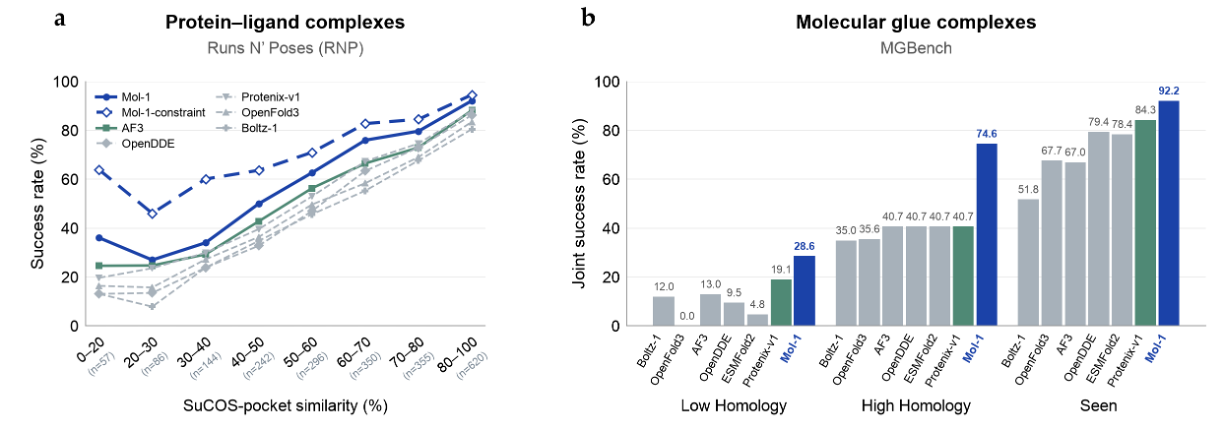
Molecular glues induce or stabilize protein–protein interactions, offering a route to therapeutic mechanisms such as targeted protein degradation (Konstantinidou and Arkin, 2024). Predicting their ternary complexes requires resolving both the protein–protein interface and the small molecule’s contacts with its binding partners. We evaluate Mol-1 using the MGBench study’s Seen, High Homology, and Low Homology groups. In the low-homology subset, it reached 28.6%, compared with 19.1% for the strongest baseline. (Figure 2 - b)
Protein–Peptide Complexes
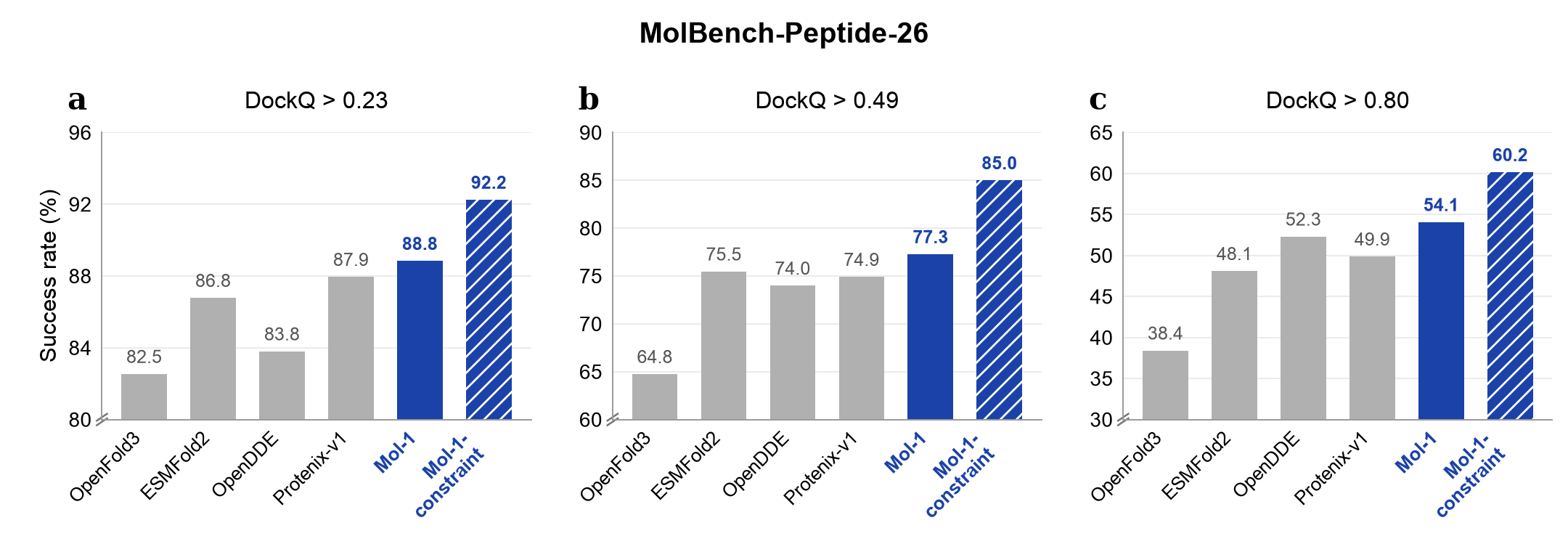
We built MolBench-Peptide-26 to evaluate peptide recognition on recent experimental structures. It comprises 172 interface clusters from 150 PDB entries released in the first three quarters of 2026. Mol-1 achieves success rates of 88.8%, 77.3%, and 54.1% at DockQ thresholds of 0.23, 0.49, and 0.80, respectively, exceeding baselines shown at each threshold. At the strictest threshold (DockQ > 0.80), Mol-1 maintained its lead over the strongest unconditioned baseline (54.1% versus 52.3%), while Mol-1-Constraint raised the success rate further to 60.2%.
Releasing Mol-1 in the Open
Today, we are releasing the base version of Mol-1 through GitHub and providing access to both the base and constraint-conditioned versions through Molence Lab.
We hope researchers will bring their own biological questions to Mol-1, test it on questions beyond those studied here, and use its predictions to inform new experiments. We look forward to learning from what the community discovers—where Mol-1 proves useful, where it falls short, and what new approaches those findings make possible.
This release is one step toward our broader ambition: pushing the frontiers of biomolecular intelligence to help turn molecular insight into better medicines and, ultimately, bring us closer to a future in which every disease can be cured.