
Although biomolecular foundation models like Mol-1 are increasingly powerful at predicting the structures of various types of complexes, structure prediction and assembly of very large protein complexes remain substantial challenges. Yet many large assemblies are also highly valuable and directly tied to therapeutics: the 20S proteasome and p97 are oncology targets, HBV capsid assembly is the target of capsid assembly modulators in clinical development (Janssen et al., 2023), and AAV capsids are the delivery vehicles of approved gene therapies (Mendell et al., 2017; Russell et al., 2017). However, determining the structure of one experimentally by cryo-EM can take an expert months to years, and some are too flexible or heterogeneous to resolve at all.

The Scaling of Biomolecular Structure Prediction
The largest complex actually predicted by AlphaFold 3 was reported to be the 40S ribosomal subunit, with 7,663 residues. Anthropic’s Big mode (Claude Science et al., 2026) then ran predictions for a set of molecular machines ranging from 4k to about 11k tokens on an 8-GPU node, with the largest accurately predicted complex containing 10,761 tokens. At capsid scale—seven complete viral capsids and protein shells of roughly 31k to 70k residues, on a node of eight B300 GPUs—every prediction collapsed (Claude Science et al., 2026).
Building on Mol-1, we built a long-running agent that predicts the structures of complex assemblies of up to 60,000 tokens, reaching 6× the scale achieved by previous approaches, while running for tens of hours on a single NVIDIA H20 GPU. As shown in Figure 1, 8 out of 10 assemblies were accurately predicted with a TM-score (Zhang, 2008) of 0.90 or more, and 9 out of 10 outperformed previously reported results (Claude Science et al., 2026) by a substantial margin. The accurately predicted assemblies included five viral capsids for which previous methods had produced collapsed structures. None of these complex structures were included in the training set.
How the Agent Works
Why is it challenging to predict these large assemblies? First, their token counts often far exceed the crop sizes used during model training, making it difficult for models to capture global topological relationships and generate plausible overall conformations, potentially leading to structural collapse. Second, for methods that assemble complexes from local structures, the candidate assembly space grows combinatorially as chain and token counts increase. Furthermore, errors can accumulate as the assembly grows, since these local predictions are themselves imperfect.
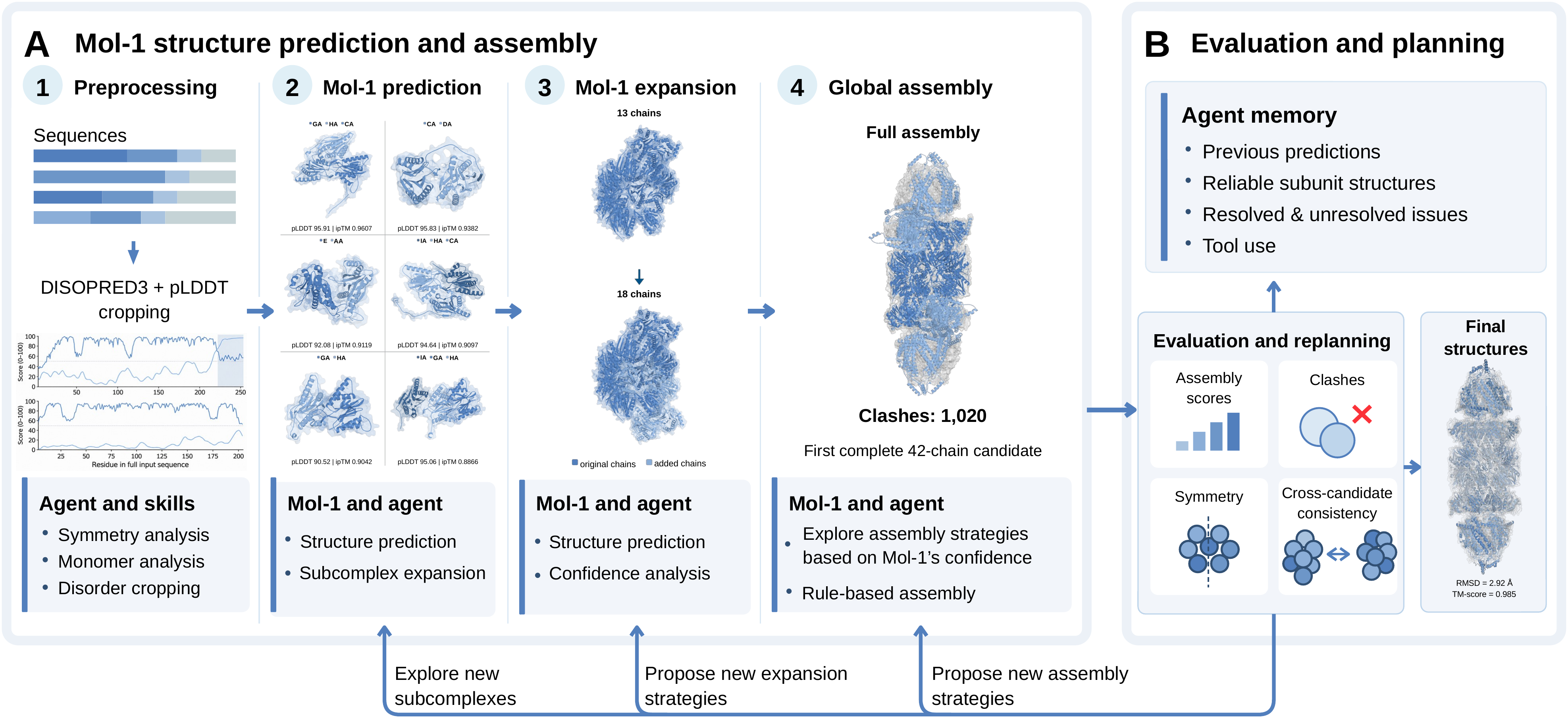
To address these challenges, we developed an agent-driven multistage framework for structure prediction and assembly that integrates the high-accuracy structure prediction capabilities of Mol-1, previously validated expert knowledge in structure prediction (Liu et al., 2026; Shor & Schneidman-Duhovny, 2024; Wang et al., 2026), and the task planning, hypothesis generation, and strategy validation capabilities of LLMs. We also incorporated additional objective evaluation metrics into the iterative loop, including cross-candidate structural consistency and backbone steric clash assessment. The framework has two modules.
Generation and Assembly of Structures
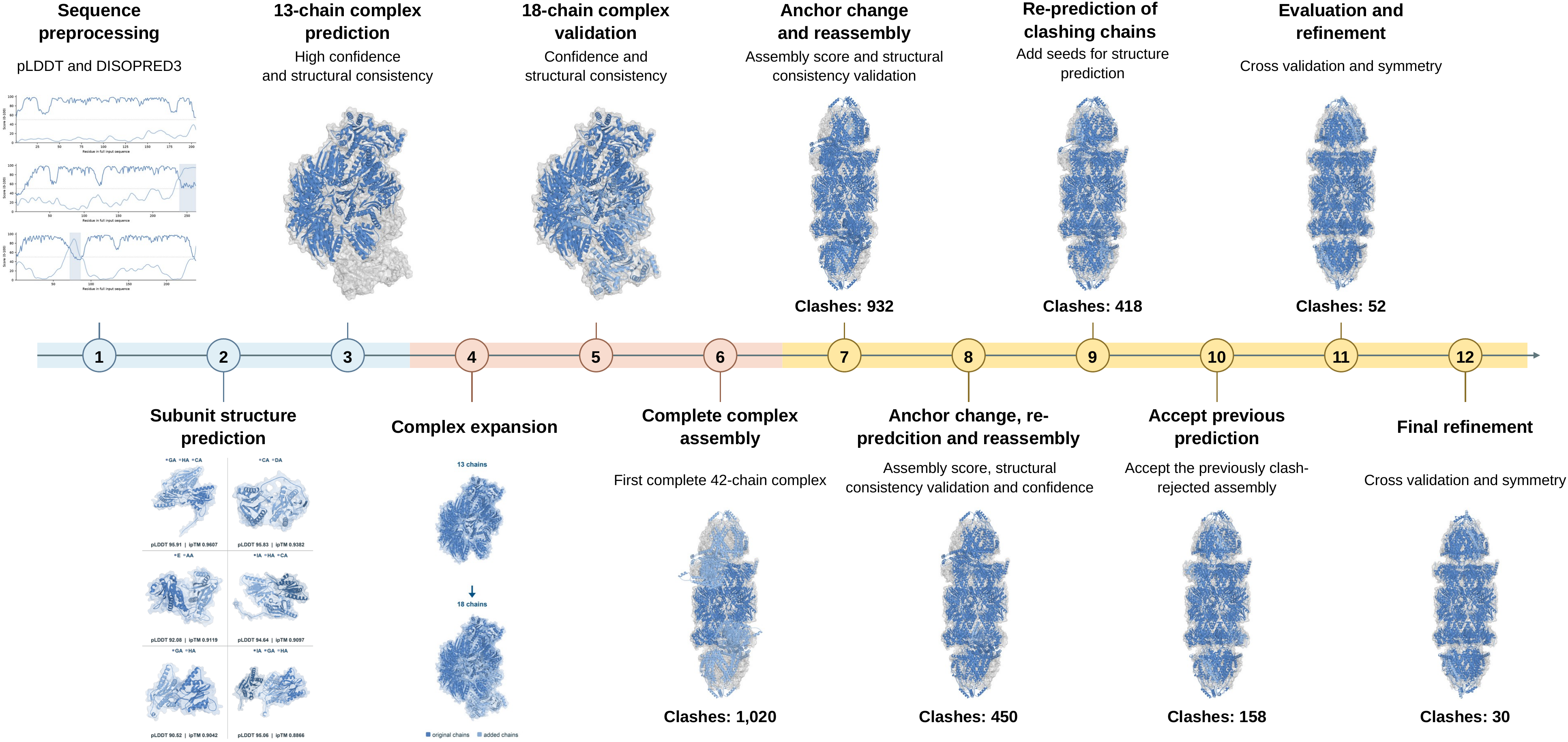
Monomer and symmetry analyses, combined with DISOPRED3 (Jones & Cozzetto, 2015) and pLDDT scores, identify and remove disordered or low-confidence regions during assembly to avoid clashes. The agent predicts local subcomplexes, selects reliable combinations using confidence scores, and expands them into progressively larger ones. It then generates 16 full-complex candidates using different assembly strategies.
Evaluation and Planning
The agent scores each candidate on assembly confidence, steric clashes, symmetry, and cross-candidate consistency, retaining previous predictions, reliable substructures, identified problems, and tool-use history in memory. Guided by these scores, it revises its strategy for subcomplex exploration, expansion, and global assembly, looping through prediction, evaluation, and replanning until the stopping criteria are met. Difficult assemblies are conventionally handled with hand-tuned heuristics; here, the choice of tool and strategy is driven by sequence features and evaluation feedback, and hard cases simply receive a longer iteration budget.
References
- Claude Science, Shuai, R., Badkundri, R., Fan, V., Fatras, K., Jarosch, L., & Shanehsazzadeh, A. (2026). Accelerating open-source biomolecular models with Claude [Technical report]. Anthropic. https://www-cdn.anthropic.com/e96b5807039a88168733d9687afe41dfbbd5de13.pdf
- Janssen, H. L. A., Hou, J., Asselah, T., Chan, H. L. Y., Zoulim, F., Tanaka, Y., Janczewska, E., Nahass, R. G., Bourgeois, S., Buti, M., Lampertico, P., Lenz, O., Verbinnen, T., Vandenbossche, J., Talloen, W., Kalmeijer, R., Beumont, M., Biermer, M., & Shukla, U. (2023). Randomised phase 2 study (JADE) of the HBV capsid assembly modulator JNJ-56136379 with or without a nucleos(t)ide analogue in patients with chronic hepatitis B infection. Gut, 72, 1385–1398. https://doi.org/10.1136/gutjnl-2022-328041
- Jones, D. T., & Cozzetto, D. (2015). DISOPRED3: Precise disordered region predictions with annotated protein-binding activity. Bioinformatics, 31, 857–863. https://doi.org/10.1093/bioinformatics/btu744
- Liu, J., Neupane, P., & Cheng, J. (2026). Improving AlphaFold2- and AlphaFold3-based protein complex structure prediction with MULTICOM4 in CASP16. Proteins: Structure, Function, and Bioinformatics, 94, 131–141. https://doi.org/10.1002/prot.26850
- Mendell, J. R., Al-Zaidy, S., Shell, R., Arnold, W. D., Rodino-Klapac, L. R., Prior, T. W., Lowes, L., Alfano, L., Berry, K., Church, K., Kissel, J. T., Nagendran, S., L’Italien, J., Sproule, D. M., Wells, C., Cardenas, J. A., Heitzer, M. D., Kaspar, A., Corcoran, S., . . . Kaspar, B. K. (2017). Single-dose gene-replacement therapy for spinal muscular atrophy. New England Journal of Medicine, 377, 1713–1722. https://doi.org/10.1056/NEJMoa1706198
- Russell, S., Bennett, J., Wellman, J. A., Chung, D. C., Yu, Z.-F., Tillman, A., Wittes, J., Pappas, J., Elci, O., McCague, S., Cross, D., Marshall, K. A., Walshire, J., Kehoe, T. L., Reichert, H., Davis, M., Raffini, L., George, L. A., Hudson, F. P., . . . Maguire, A. M. (2017). Efficacy and safety of voretigene neparvovec (AAV2-hRPE65v2) in patients with RPE65-mediated inherited retinal dystrophy: A randomised, controlled, open-label, phase 3 trial. The Lancet, 390, 849–860. https://doi.org/10.1016/S0140-6736(17)31868-8
- Shor, B., & Schneidman-Duhovny, D. (2024). CombFold: Predicting structures of large protein assemblies using a combinatorial assembly algorithm and AlphaFold2. Nature Methods, 21, 477–487. https://doi.org/10.1038/s41592-024-02174-0
- Wang, W., Luo, Y., Peng, Z., & Yang, J. (2026). Accurate biomolecular structure prediction in CASP16 with optimized inputs to state-of-the-art predictors. Proteins: Structure, Function, and Bioinformatics, 94, 142–153. https://doi.org/10.1002/prot.70030
- Zhang, Y. (2008). I-TASSER server for protein 3D structure prediction. BMC Bioinformatics, 9, Article 40. https://doi.org/10.1186/1471-2105-9-40